The 30-second version
What happened: On 21 May 2026, Eli Lilly published topline TRIUMPH-1 Phase 3 results for retatrutide. Average weight loss at 12 mg was 28.3% over 80 weeks — pushing into territory previously associated only with bariatric surgery.
Why it matters: Retatrutide now sits clearly above Mounjaro (~22.5%) and Wegovy (~20.7%) on weight outcomes in published trials. It is also the first weight-loss drug where no plateau was observed across the trial period.
The catch — and the workaround: Retatrutide is still not licensed in the UK. Realistic MHRA approval lands in late 2027 or 2028. UK buyers who want to buy retatrutide now do so via the wellness-product market, where UK-finished retatrutide pens like the Reta Pen 40 are already available.
If you have been following the GLP-1 space for the last two years, the May 2026 TRIUMPH-1 readout is the moment everyone was waiting for. The Phase 2 data hinted at something genuinely different. The Phase 3 data has now confirmed it. Whether you came to this page to understand the numbers or to figure out how to buy retatrutide in the UK right now, this is the breakdown you actually need — not the press-release copy. We cover the data, the side effects, the realistic UK availability timeline, and exactly how to buy retatrutide today if you decide that is the right move for you.
What's in this guide
- What actually happened on 21 May 2026
- The headline numbers (and what's hidden in them)
- Why the 45.3% figure is a watershed moment
- Why retatrutide works differently to Mounjaro and Wegovy
- The full trial data — doses, outcomes and side effects
- Retatrutide vs Mounjaro vs Wegovy — head-to-head
- When will retatrutide be available in the UK?
- The NHS question — what NICE approval looks like
- Should you wait, or buy retatrutide now?
- What comes next — the seven remaining TRIUMPH trials
- The bottom line for UK readers
- FAQ
What actually happened on 21 May 2026
Four days ago, Eli Lilly — the pharmaceutical company that already owns the dominant tirzepatide brand — released the topline results of TRIUMPH-1, its first major registrational Phase 3 trial of retatrutide in adults with obesity. Within hours, search interest from people looking to buy retatrutide in the UK and Europe spiked to its highest level in 18 months.
This was the trial the entire metabolic-health space had been pointing at since the Phase 2 results were published in The New England Journal of Medicine in 2023. The Phase 2 numbers were already startling, and they drove the first major wave of UK buyers looking to buy retatrutide outside the licensed-medicine route. The question for TRIUMPH-1 was whether those Phase 2 numbers would hold up in a much larger, longer Phase 3 trial — the kind of trial regulators actually use to approve medicines.
The answer is yes. The numbers didn't just hold — they got bigger.
TRIUMPH-1 enrolled 2,339 participants with obesity, randomised across four arms: retatrutide 4 mg, 9 mg, 12 mg, or placebo. Doses were built up gradually every four weeks from a 2 mg starting point. The trial ran for 80 weeks, with a 24-week extension for participants who tolerated the 9 mg or 12 mg dose.
The numbers reported on 21 May 2026:
- 4 mg dose: 17.6% average body weight loss at 80 weeks
- 9 mg dose: 23.7% average body weight loss at 80 weeks
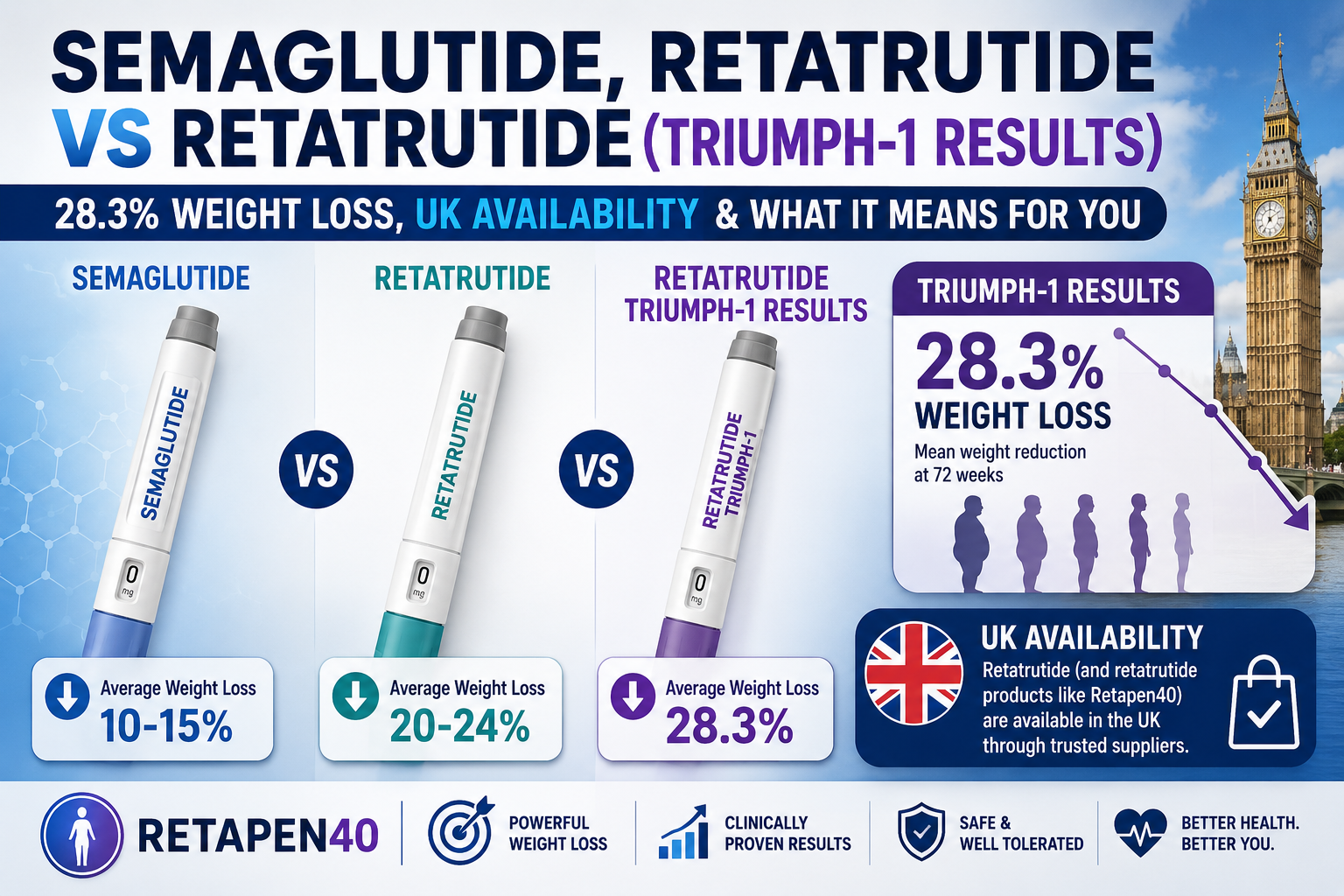
- 12 mg dose: 25.0% average body weight loss at 80 weeks — rising to 28.3% on the efficacy estimand
- Placebo: 3.9% average body weight loss at 80 weeks
And then the extension cohort — 532 participants with starting BMI ≥35, escalated to their maximum tolerated dose for another 24 weeks — lost an average of 30.3% of their body weight at 104 weeks. That is roughly a third of their starting body weight, lost over two years on a once-weekly injection.
Why journalists keep using the word "unprecedented"
Outside of bariatric surgery, no obesity treatment in history has ever produced average weight losses in this range. Tirzepatide's best Phase 3 numbers landed around 22.5%. Semaglutide's best around 20.7%. Retatrutide's worst arm at 4 mg matched what older drugs achieved at their best doses. This is the data point that has UK readers asking, in growing numbers, where they can buy retatrutide right now.
The headline numbers — and what's hidden inside them
Big topline figures hide as much as they reveal. The really telling parts of TRIUMPH-1 are the secondary endpoints, not the average.
The "no plateau" finding
The single most striking observation from the trial is what didn't happen: participants didn't stop losing weight. In every previous large weight-loss trial — semaglutide's STEP programme, tirzepatide's SURMOUNT trials — the curve flattens somewhere between months 12 and 18. The body adjusts; weight loss stabilises; further loss requires further intervention.
In TRIUMPH-1, the weight-loss curve was still descending at 80 weeks. The extension cohort confirmed it: pushed out to 104 weeks, the curve kept going. This is the first weight-loss drug where the answer to "how long can you stay on it before the effect levels off?" appears to be much longer than the trial duration.

The ≥30% threshold
The headline that has been everywhere in the medical press: 45.3% of participants on the 12 mg dose achieved at least 30% body weight loss. To put that in context, 30% body weight loss is the threshold historically associated with bariatric (weight-loss) surgery. Anything pharmaceutical that gets close to that figure is genuinely new. Anything that puts nearly half the trial population past it is, in clinical terms, a category shift.
Cardiometabolic improvements
Underneath the weight numbers sit the metabolic markers, which often matter more than the scale figure for long-term health:
- Waist circumference reduction of 24.1 cm (9.5 inches) on average at 12 mg — a marker of visceral fat reduction, the metabolically dangerous kind
- Reductions in non-HDL cholesterol and triglycerides
- Reduction in systolic blood pressure
- Reduction in high-sensitivity C-reactive protein — a marker of systemic inflammation
Each of these on its own would be an interesting finding. Stacked, they describe a metabolic profile shift, not just a body composition shift.
Why the 45.3% figure is a watershed moment
It is worth pausing on this number specifically, because it is the one that changes how the entire obesity-treatment field thinks about pharmacotherapy.
Until very recently, the implicit understanding among clinicians was simple: if a patient needed to lose more than 25-30% of their body weight, pharmacotherapy alone was not enough. Surgery was the only route. Drugs were for the "less severe" end of obesity; surgery was for the "more severe" end.
Tirzepatide started to erode that line. Retatrutide, with TRIUMPH-1, has effectively erased it. When nearly half of trial participants on the highest dose cross the 30% threshold — without surgery, without major lifestyle interventions described as the dominant variable, just a once-weekly injection — the clinical framing shifts.
This matters for UK readers in two specific ways. First, it changes what counts as a reasonable expectation when discussing weight-loss medication with a clinician. Second, it changes the economic case for NICE: a drug that produces surgery-grade outcomes without surgery's overhead is a different calculation than one that produces modest weight loss. Third — and this is the practical one — it explains why the demand to buy retatrutide in the UK has already outrun the licensed-medicine timeline.
Why retatrutide works differently to Mounjaro and Wegovy
The reason TRIUMPH-1 produced these numbers is not luck. It is mechanism. Understanding it in one sentence is worth two minutes of reading.
Semaglutide (sold as Wegovy in the UK weight-loss indication) acts on one receptor — GLP-1. Tirzepatide (Mounjaro) acts on two — GLP-1 and GIP. Retatrutide acts on three — GLP-1, GIP, and glucagon.
The GLP-1 pathway primarily reduces appetite and slows gastric emptying. Adding GIP, as tirzepatide does, contributes additional insulin and fat metabolism effects. Adding glucagon, as retatrutide does, is the one that changes the picture: glucagon receptor activity can increase energy expenditure. In simple terms, where the previous generations told the body to eat less, retatrutide tells the body to both eat less and burn more.
That is the mechanistic explanation for why retatrutide produces larger trial outcomes, and why the weight-loss curve does not plateau in the same way. It is also the reason a growing share of UK readers researching the GLP-1 space ultimately decide to buy retatrutide rather than stay on tirzepatide or semaglutide. You can read a deeper breakdown of all three peptides in our retatrutide vs tirzepatide vs semaglutide comparison.
The full trial data — doses, outcomes and side effects
This is the level of detail most press coverage skips. Anyone making a real decision about whether to wait for licensed retatrutide or buy retatrutide through the UK wellness-product market needs to see it in full.
TRIUMPH-1 efficacy table
| Dose | Avg. weight loss (80 weeks) | Avg. weight loss (efficacy estimand) | % achieving ≥30% loss | Discontinuation (adverse events) |
|---|---|---|---|---|
| Placebo | 3.9% | 3.9% | 0.8% | 4.9% |
| Retatrutide 4 mg | 17.6% | — | — | 4.1% |
| Retatrutide 9 mg | 23.7% | — | 30.5% | 6.9% |
| Retatrutide 12 mg | 25.0% | 28.3% | 45.3% | 11.3% |
The side-effect profile
The honest picture: retatrutide produces the largest outcomes and the highest discontinuation rates in the class. Both are dose-dependent.
From TRIUMPH-1, discontinuation rates due to adverse events were:
- 4 mg: 4.1% — in line with placebo (4.9%)
- 9 mg: 6.9%
- 12 mg: 11.3%
The specific side effects mirror the rest of the GLP-1 class — they are gastrointestinal. From the earlier TRANSCEND-T2D-1 Phase 3 trial in March 2026:
- Nausea: 26.5% on the highest dose
- Diarrhoea: 22.8% on the highest dose
- Vomiting: 17.6% on the highest dose
A small number of participants also experienced dysesthesia, an unpleasant nerve sensation. Modest increases in heart rate — a known feature of the class — were also observed.
How to read the side-effect picture
The 11.3% discontinuation rate at 12 mg is higher than tirzepatide or semaglutide at their licensed doses, but not by a wide margin. The clinical interpretation is that retatrutide is broadly tolerated by the same population that tolerates the older drugs — with a slightly higher proportion stopping at the highest dose. Side effects are dose-dependent and largely concentrated in the titration phase, not the maintenance phase.
The TRIUMPH-4 osteoarthritis data — a reminder
One thing worth flagging from TRIUMPH-4 (published December 2025), because it gets less coverage than the weight-loss numbers: in participants with obesity and knee osteoarthritis, retatrutide 12 mg produced an average 75.8% reduction in WOMAC pain scores, with more than one in eight participants ending the trial completely free of knee pain. The mechanism is presumed to be a combination of weight reduction and direct anti-inflammatory effect from the glucagon pathway.